
Meaning of Mark 7:24-30
Demon Possession, Dog Food, Dirty Tables

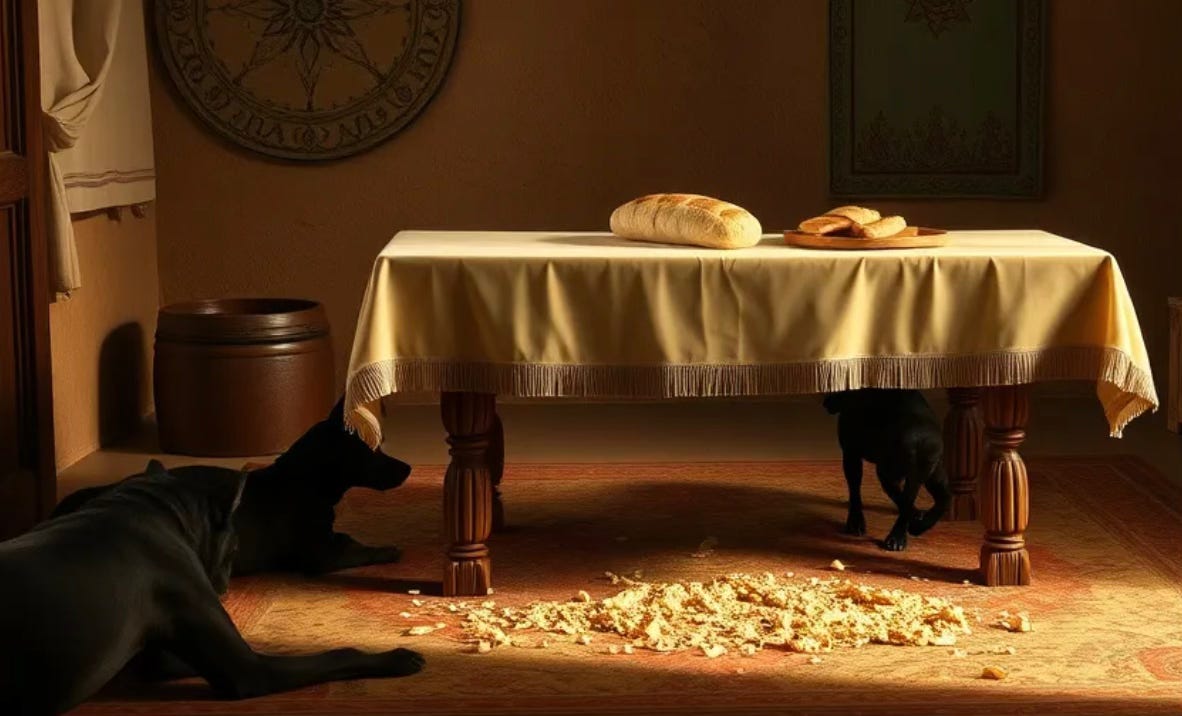
Of all the passages in Scripture that make us pause and ask, “What did Jesus mean by that?” Mark 7:24–30 may be among the most puzzling.
As the Master Communicator, Jesus does not always communicate in the same way.
Oftentimes, He preaches straightforwardly—with direct commands and clear truth.
Sometimes, He teaches strategically—through parable, story, and questions that invite deeper reflection.
Other times, He speaks in subtlety—drawing on assumptions, wordplay, and rich nuance to make a point.
The latter is exactly what happens in Mark 7:24-30. As Jesus speaks with a Syrophoenician woman, He draws on certain nuances of their ancient context—one that is simply lost on us today. And that’s precisely why Jesus’ response is confusing to us, but clear to her.
In their conversation, there’s a lot going on: Demon possession. Dog food. Crumbs under the table. Leftovers in the fridge. And a statement of faith so powerful that it delivers a little girl in real time.
And, did Jesus insult the woman in the process? If not, then what?
Let’s sort through it. Immediately below, I have inserted Tim Keller’s explanation, taken straight from his book, Jesus The King. Then following, I’ve included a handful of additional applications we just can’t skip over from such a rich passage.
Jesus left that place and went to the vicinity of Tyre. He entered a house and did not want anyone to know it; yet he could not keep his presence secret. In fact, as soon as she heard about him, a woman whose little daughter was possessed by an evil spirit came and fell at his feet. The woman was a Greek, born in Syrian Phoenicia. She begged Jesus to drive the demon out of her daughter. (Mark 7:24–26)
The story begins with the mysterious statement that Jesus went to the vicinity of Tyre and did not want anyone to know it. What was going on? Well, Jesus had been spending all of his time ministering in Jewish provinces, and that ministry was drawing overwhelming crowds, and he was exhausted. So Jesus left the Jewish provinces and went into a Gentile territory, Tyre, in order to get some rest.
But it doesn’t work. A woman hears of his arrival and makes her way boldly to Jesus. Though she’s a Syrophoenician, because of Tyre’s proximity to Judea she would have known the Jewish customs. She knows that she has none of the religious, moral, and cultural credentials necessary to approach a Jewish rabbi—she is a Phoenician, a Gentile, a pagan, a woman, and her daughter has an unclean spirit. She knows that in every way, according to the standards of the day, she is unclean and therefore disqualified to approach any devout Jew, let alone a rabbi. But she doesn’t care. She enters the house without an invitation, falls down and begins begging Jesus to exorcise a demon from her daughter. The verb beg here is a present progressive—she keeps on begging. Nothing and no one can stop her. In Matthew’s Gospel chapter 15, the parallel account, the disciples urge Jesus to send her away. But she’s pleading with Jesus—she won’t take ‘no’ for an answer.
You know why she has this burst of boldness, don’t you? There are cowards, there are regular people, there are heroes, and then there are parents. Parents are not really on the spectrum from cowardice to courage, because if your child is in jeopardy, you simply do what it takes to save her. It doesn’t matter whether you’re normally timid or brazen—your personality is irrelevant. You don’t think twice; you do what it takes. So it’s not all that surprising that this desperate mother is willing to push past all the barriers.
So what is Jesus’ response to this woman as she is down on the floor begging? The story continues:
She begged Jesus to drive the demon out of her daughter. “First let the children eat all they want,” he told her, “for it is not right to take the children’s bread and toss it to their dogs.” (Mark 7:26–27)
On the surface, this appears to be an insult. We are a canine-loving society, but in New Testament times most dogs were scavengers—wild, dirty, uncouth in every way. Their society was not canine-loving, and to call someone a “dog” was a terrible insult. In Jesus’ day the Jews often called the Gentiles “dogs” because they were considered “unclean.” Is what Jesus says to her just an insult, then? No, it’s a parable. The word parable means “metaphor” or “likeness,” and that’s what this is. One key to understanding it is the very unusual word Jesus uses for “dogs” here. He uses a diminutive form, a word that really means “puppies.” Remember, the woman is a mother.
Jesus is saying to her, “You know how families eat: First the children eat at the table, and afterward their pets eat too. It is not right to violate that order. The puppies must not eat food from the table before the children do.” If we go to Matthew’s account of this incident, he gives us a slightly longer version of Jesus’s answer in which Jesus explains his meaning: “I was sent only to the lost sheep of Israel.”
Jesus concentrated his ministry on Israel, for all sorts of reasons. He was sent to show Israel that he was the fulfillment of all Scripture’s promises, the fulfillment of all the prophets, priests, and kings, the fulfillment of the temple. But after he was resurrected, he immediately said to the disciples, “Go to all the nations.” His words, then, are not the insult they appear to be. What he’s saying to the Syrophoenician woman is, “Please understand, there’s an order here. I’m going to Israel first, then the Gentiles (the other nations) later.” However, this mother comes back at him with an astounding reply:
“Yes, Lord,” she replied, “but even the dogs under the table eat the children’s crumbs.” Then he told her, “For such a reply, you may go; the demon has left your daughter.” She went home and found her child lying on the bed, and the demon gone. (Mark 7:28–30)
In other words, she says, “Yes, Lord, but the puppies eat from that table too, and I’m here for mine.” Jesus has told her a parable in which he has given her a combination of challenge and offer, and she gets it. She responds to the challenge: “Okay, I understand. I am not from Israel, I do not worship the God that the Israelites worship. Therefore, I don’t have a place at the table. I accept that.”
Isn’t this amazing? She doesn’t take offense; she doesn’t stand on her rights. She says, “All right. I may not have a place at the table—but there’s more than enough on that table for everyone in the world, and I need mine now.” She is wrestling with Jesus in the most respectful way and she will not take ‘no’ for an answer. I love what this woman is doing.
In Western cultures we don’t have anything like this kind of assertiveness. We only have assertion of our rights. We do not know how to contend unless we’re standing up for our rights, standing on our dignity and our goodness and saying, “This is what I’m owed.” But this woman is not doing that at all. This is rightless assertiveness, something we know little about. She’s not saying, “Lord, give me what I deserve on the basis of my goodness.” She’s saying, “Give me what I don’t deserve on the basis of your goodness—and I need it now.”1
Keller explains the nuance and unearths the meaning so well.
The context, as always, brings the cryptic into clarity.
For paid subscribers—let’s now explore more deeply what this passage means in the larger story of Scripture and in our own lives as well.
Here are 3 deeper implications and applications:
